









[AI generated, themed image]
The discussion to rename a local street after an R&B group invoked some old racial wounds on Monday.
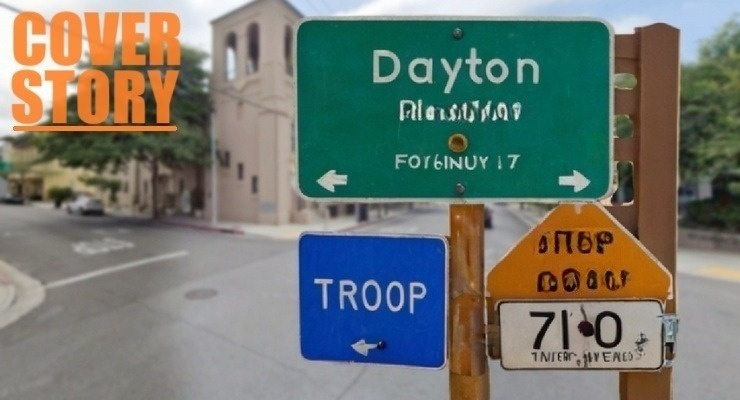
Some Black residents who called on the City Council to rename a small portion of Dayton Street to Troop Way reminded the City that although now the area is part of trendy upscale Old Pasadena, it was once a Black community before it was devastated by a doomed freeway project.
Troop had three number one hits in the late ’80s. Members of the group went to Pasadena High School.
The City Council voted on Monday to honor the group meaningfully but did not vote to change the street name to honor it.
People living on several streets, not all in Old Pasadena, have now said they did not want their street names changed.
Local residents living in the historic Castle Green located on Dayton Street said the group should be honored but opposed changing Dayton Street, citing the street’s connection with the hotel.
“We are celebrating our 125th year this year. We had a commemoration in January, and we are going to be celebrating our 125th year all year,” said Michelle Hooker. “And we’re very proud of the Dayton Street name. It is historic and we understand the significance of it. We joined with the other streets like Catalina, whose constituency has also said that they did not want their street name changed. And also Morton Street, their constituency also said they didn’t want their street name changed either. I just feel that we’re the same as them. We just want to keep our historic name. We’re in a historic district, we’re in a historic block, and our building is 125 years old. So we’re just really proud of it. Thank you very much.”
Stories differ on the origin of Dayton Street. On Monday, Vice Mayor Steve Madison said the street is named after one of the city’s early families.
Black residents pointed out they too have a historical connection to the area, which was once a predominantly Black neighborhood before scores of homes and businesses were destroyed to make way for the 710 freeway.
Expansion and Eviction
On Nov. 18, 1964, the California Highway Commission determined the final five miles of freeway — now known as the SR 710 — would go through Pasadena, South Pasadena and El Sereno to complete the Long Beach Freeway.
At least 4,000 residents were displaced and 1,500 homes and commercial buildings were demolished.
A majority of the homes were owned or rented by low-income residents and people of color.
Other homes were not destroyed and now the state has finally begun the slow bureaucratic process of selling the homes, many of them in need of repair.
According to National Public Radio, the Federal Aid Highway Act of 1956 routed some highways directly through Black and Brown communities.
The freeway never materialized in El Sereno and South Pasadena, but the SR 710 northern interchange was constructed in the City of Pasadena in the early 1970s, resulting in the Northern Stub.
After years of opposition of the freeway extension through West Pasadena, the City reclaimed 50 acres of the 710 stub in 2022 when California Department of Transportation formally relinquished the stub to the City.
And that’s where supporters want to honor the group.
“It used to be a black neighborhood and it does hold some historic value to us,” said Olden Dunham.
Although some members of the community mentioned the past and supported honoring the group in the now prestigious Old Pasadena area, the City Council focused on the issue for the most part.
“I’m not making this a Black thing. I’m not making this a white thing. This is a people thing,” said Councilmember Tyron Hampton.
Councilmember Jason Lyon spoke about the cultural impacts of the issue.
Lyon originally supported changing the name of Dayton to Troop Way, but after the substitute motion was made to honor the group he agreed to vote in favor of that motion.
An earlier substitute motion to honor the group while establishing a policy to rename streets failed 4-4. Lyon agreed to change his vote and support honoring the group if the lengthy process of establishing policy was separated from the motion.
“It is clear that this process has invoked a lot of cultural pain,” Lyon said. “That’s probably more important than any of the other policies that we’re looking at. Any of the specifics about whether this street should be it or whether the neighbors like it or don’t are not worth driving that pain.”
Nationwide problem
Pasadena is not the only community that is struggling with the racial impacts of freeway displacement in communities of color. The expansion of freeways decimated Black communities across the country and in many of those communities across the country discussions surrounding those impacts are ongoing.
Work continues in Miami on the Underdeck, an upscale destination location. However, in the 1950s, the area was known as Overtown, the Harlem of the South frequented by Black celebrities, including Ella Fitzgerald and Louie Armstrong.
And then it was flattened to make way for a highway.
Now some Black residents say they are once again being left out of discussions regarding the fate of a neighborhood they once populated.
“Ask yourself, who is this space going to be for? And when they say it’s for the residents of Overtown, which residents? Is it those that are there now that won’t be there, or those that will be living in all those high-rise buildings looking down on that space?” Architect Ron Frazier told the Miami Times in 2022.
Local History
Locally, the City has an educational memorial at the Parson’s project which details the displacement.
The City has also empaneled the 710 Reconnecting Communities 710 Advisory Group, which is doing its work while the City contemplates what to do with the once hijacked space.
The late John J. Kennedy told Pasadena Now that the City had to remain mindful of the past its contemplates the future of the 719 freeway.
Over the past several years, a movement has started to give land back to the people who lost it.
California lawmakers unanimously passed legislation to allow the return of Bruce Beach, once a thriving coastal resort that catered to Black residents when racial segregation barred them from many beaches, to the family this year.
Kavon Ward has started Where Is My Land, an organization dedicated to helping families with similar stories reclaim what once belonged to them.
“The repatriation of the 710 Freeway Stub to the City of Pasadena is little different than the return of Bruce Beach in Manhattan Beach to the African American family who had the land stolen from them almost 100 years ago,” Kennedy told Pasadena Now. “Bruce Beach is valued at around $20 million dollars, a conservative estimate.”
According to Kennedy, a rough estimate of the value of the land at the 710 Stub is possibly into the several billions of dollars.
“The critical piece to keep in mind is that African American and other minority groups had their land taken from them via the evils of eminent domain actions,” he said.
Kennedy said the 52 acres can help solve the housing crisis in Pasadena, establish much-needed green space for children and families, create tremendous opportunities for small businesses and “simply unify our geographical plain.”
But he cautioned, the community must be heard, public hearings must take place and an overall empathetic and respectful framework announced for consideration.
Doing the work
Nationally, President Biden’s $3.5 trillion infrastructure plan is designed in part to address racism ingrained in historical transportation and urban planning by earmarking $20 billion for a program that would “reconnect neighborhoods cut off by historic investments,” according to the Biden administration.
He pledged “to right historic wrongs and, in the process, deliver environmental justice to disadvantaged neighborhoods.”
“When the freeway came through there, the 710 Freeway, you demolished all the African-American houses,” said Don Rodell.
“That was an African-American community. Reverend Martin Luther King was in that church over there. This is an African-American community right there. It should be named for Troop.”
In 1960, the Civil Rights leader came to the area at the invitation of Pastor Marvin Robinson of Pasadena’s Friendship Baptist Church located on Dayton Street and DeLacey Avenue.
Robinson and King had been corresponding for some time. Robinson invited King to speak at the church on several occasions.
King finally found time in 1960 when he was on a fundraising trip to Southern California.
There’s more history, Civil Rights leader and King confidante Bayard Rustin was arrested just a few blocks away on Green Street and Raymond Avenue.
His wife, Coretta Scott King, was invited back to Friendship Baptist Church on April 24, 1966.
There is no plaque on Dayton honoring King’s visit to the church.
 Get our daily Pasadena newspaper in your email box. Free.
Get all the latest Pasadena news, more than 10 fresh stories daily, 7 days a week at 7 a.m.


